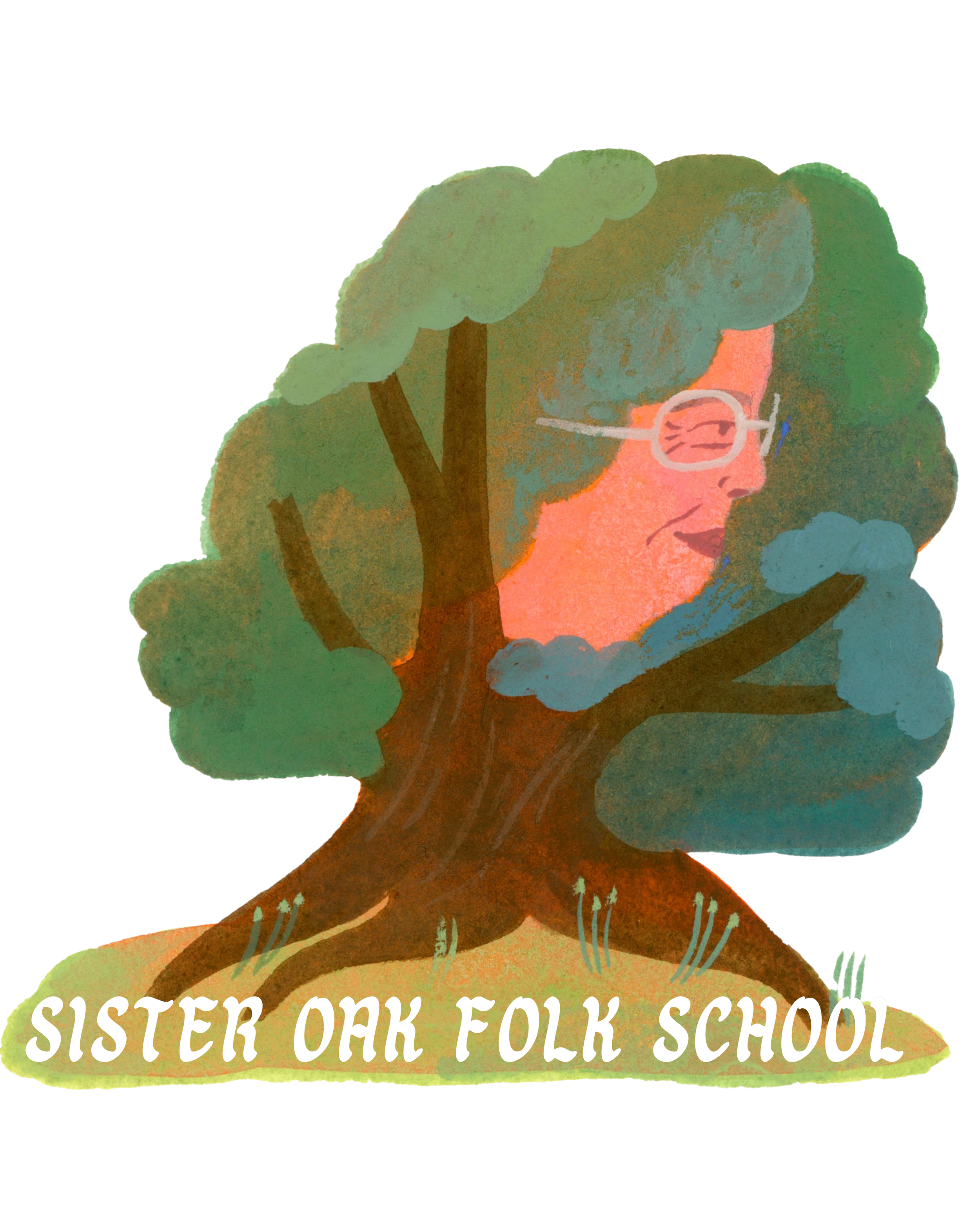
Folk Yourself is a season-long immersion in folk practice, FOR PEOPLE WHO are looking for meaning and understanding in everyday life.

Folk is a word for how we are in the world: ways of being and knowing, wondering and creating that are curious, connected with place, motivated by gratitude and wonder, rooted in meaningful lineages and traditions, and focused on making and remaking a world that will support life for future generations.

FOLK YOURSELF IS A PLACE FOR PEOPLE WHO WANT TO ASK QUESTIONS. THE BIG QUESTIONS, AND THE SMALL QUESTIONS THAT ARE ACTUALLY HUGE.

Questions like:

  • “how can i be celebrating holidays more meaningfully?”

  • “HOW DO I BELONG TO THE PLACE WHERE I LIVE?”

  • “how can i be connected to my ancestors if i only inherited a couple of recipes?”

  • “HOW DO I ESCAPE THE SCROLL CYCLE? WHAT ELSE EVEN IS THERE ANYMORE?”

  • “WHAT am i supposed to dO WITH THose NAMES OF THE FULL MOONS that’s actually authentic?”

  • “how can i think more rigorously about MY GARDENING/COOKING/CRAFT MAKING/FAMILY CARE, but not turn it into grad school?

  • “I’VE STARTED (OR I WANT TO START) FAMILY HISTORY RESEARCH/CLEANING OUT MY FAMILY HOME/INTERVIEWING MY ELDERS…NOW WHAT?”

  • “I’VE STARTED A SPIRITUAL PRACTICE…but what am i really doing?”

  • “HOW CAN I CARE ABOUT THE PAST, WHEN EVERYTHING IS SO MESSED UP IN THE PRESENT? AM I DELUSIONAL?

  • “I’m paralyzed by climate change/politics/everything, how can i do anything when i don’t really believe in a future?

over the 8-week course of FOLK YOURSELF, Together we will make personal devotionals - an altar, a piece of jewelry, a book… - that will give you a focal point, experimentation space, and basic principles for coming into your folk.

your altar will be yours, and it will also become part of a bigger conversation, in exhibitions and publications, and with feedback from experienced practitioners who will help you think through your questions and puzzles with new eyes.

SCHEDULE

8 SESSIONS : FEBRUARY 4 - MARCH 24, 2026

Feb 4, 11, 18, 25, 4, 11, 18, 25

IN PERSON in Oakland/Berkeley, California

Noon - 2pm THURSDAYS

apply now - in person section

VIRTUAL - live

9am PT / 12ET WEDNESDAYS

APPLY NOW - VIRTUAL SECTION
I am not a particularly spiritual person, at least not overtly so, but with Diana’s guidance I was able to feel a profound sense of connection to something intangible. Diana has a wonderful way of teaching and using language and associations that made this possible for me.
— A.R.
apply by december 21 for best access to all pricing tiers

A pilot, prerequisite course for Sister Oak Folk School, this is the home school grad school you always wanted: intimate, personal, informed by thorough research while allowing everyone to be a whole human -- body, heart, mind, and land -- and valuing expertise from all walks of life. 

In this course, we will engage with the radical -- roots -- of folk work. For us, folk is not decorative, nostalgic, or quaint. We are ferociously, with conviction, internet proofing and AI proofing our minds and hearts, by learning to be in real accountability with the world around us, and to our own truest selves, and to the ideas that we explore. We will also be fascism proofing ourselves, by learning to look closely at the myths and fantasies that power our world and refusing to take part in them. We will do this by engaging the foundational practice of listening and asking questions, investigating folk traditions that are meaningful and relevant to our lives, and experimenting with how to be in respectful lineage with them.

Together we will learn by doing and by reading. We will read difficult texts, consult our intuitions, and listen to the words of elders and other wise humans and non-human beings. In this course, you will not be “consuming content” : you will be collaboratively creating our learning in direct conversation with the teacher, your peers, and the community of life in which you live. 

    • from all educational backgrounds and with any level of traditional schooling, but with proficiency reading, writing, and listening in English

    • ready to engage respectfully in a collaborative exchange of ideas with people of different backgrounds

    • willing to receive feedback, iterate ideas, and be open to revising their own opinions and assumptions

    • open to experimentation, to apply and explore ideas from the course throughout the week in daily life

    • willing to commit to developing their self-devised project over the course of eight weeks

    • interested in ideating and creating in the physical world, and not just think thoughts or write words or work on a screen

    • Looking for direct interaction with a guide/teacher.

  • Diana Ruta Lempel has a lifelong love of folklore and folk traditions. Sister Oak Folk School has been a long simmering dream, as she consistently found that her students and interns needed exactly this kind of training, and her friends and colleagues also consistently sought her out for advice on developing meaningful ritual, research, and community work, which this course and future courses will consolidate and develop.

    Folk Yourself, in particular, has emerged out of Diana Ruta’s decade of research about authenticity and nostalgia, and how these very natural human concerns have become weaponized in our social media and rising authoritarian environment.

    Diana comes to folk work out of her academic training in history and social sciences, and a decade of practice in local, community based history curating, education, and storytelling. She has an MUP in Urban Planning, an MA in Landscape Studies, and an MFA in Nonfiction Writing; she considers her home field to be oral history. The variety of disciplines Diana Ruta studied helped her develop a conviction about the importance of question-asking and methods — the how of learning and engaging the world.

    Over time, these practices developed into an approach that integrated sacredness and the unknown into research, and incorporating objects and landscapes into the chorus of voices that tell stories. This combination became how she defines “folk.”

    She realized that as a history curator she was basically doing grief work — supporting individuals and communities to metabolize change and grief — and that this was a fundamental skill for herself and for others in this time when climate change has changed everything, and fear of change is motivating so much social crisis. This course is an offering into the needs of this world.

    Diana Ruta has recently returned to Ohlone land, where she was born and raised, and lives now along Codornices Creek, in Berkeley, California. She previously lived for 20 years along the Charles/Quinobequin River in Cambridge, MA, and along the Connecticut/Kwinitekw River in Western Massachusetts.

  • I am ____ identity. Is this program for me?

    Some of the identities I hold are: mother, woman, materialist feminist, descendant of the Italian and Jewish diasporas, as well as early settler-colonizers and 19th century European farmers, Californian and New Englander, and neurodivergent. If you don’t share these identities, I welcome you, and I trust that you have chosen me as your teacher because you believe that there is something that I can offer you that you need in your journey. I commit to working with you to make sure our relationship develops trust, but I can’t promise that I will do that perfectly. If you want to talk about that before you make your decision, please get in touch.

    I am atheist, is this program for me?

    I love atheists. Some of my best friends are atheists! No seriously, this course will emphasize how you relate more than it will focus on what you believe. I personally think in terms of the mystery, joy and wonder in the natural world and the wisdom of human traditions, but I know that much of what I talk about might be what others refer to as God, and sometimes I will use texts and resources that use a theistic framework, because that’s the traditional way they’ve been presented, and I’m okay with that, and okay with deleting or rephrasing all the God-words and power-words and religion-words too. If you are willing to engage with the unknown - in whatever language you choose - and ask questions about why things are the way they are, and trust that not everything that is important is what you can prove or see, then I welcome your participation! Maybe this topic will even become part of your exploration. Or maybe not.

    I already have a meditation/spiritual practice, is this program for me?

    Awesome! Your investigation in this course will be supported by your existing capacities for presence with the great mystery. My favorite courses in graduate school were always beginner ones, because they allowed me to explore fundamental questions and develop mental models without jargon or minutiae.  However, if you feel that your existing practice isn’t open to new ideas, questions, or instruction, or if you feel for whatever reason that right now you’re not interested in returning to beginner questions or being around beginners, this might not be the course for you at the moment. Stay tuned for future offerings that might be more in sync with your goals. Also, see the above answer about atheism, which may also be relevant, but in the reverse, if that makes sense.

    Where does the money go?

    I do not have to work for a living because of the wealth generated by my husband’s former work as a tech investor. The start up funds for Sister Oak Folk School however are coming from my personal savings from income generated by previous employment, and ongoing operating expenses will be supported by tuition. Because I do not need to make an income myself, my portion of school income will be redistributed and reinvested into folk-affiliated initiatives. My intention is for this to be relational and transparent over time. If you want to recommend a recipient, please let me know; when a surplus becomes available for redistribution, I will share this.

    I cant make the times, but I’m interested -- why don’t you have nights or weekends?

    I am mother to two very intense kids and also sustain family and community commitments locally. It is not possible for me to have a work life at all unless it takes place during very specific hours. My hope is that eventually additional instructors will be able to offer courses with different schedules and sections at different times. If you are interested in learning about asynchronous options for this iteration of Folk Yourself, please get in touch.

    I don’t love reading. Will I struggle in this class?

    You might! But you won’t do it without loving support. My hope is that if reading is challenging for you, this class might help.

    Most of our text-reading will take place during class hours, with plenty of instruction. We will also have a guest/supplemental instructor who has specific expertise in guiding adult learners through difficult texts. I personally love audio books and audio resources (I’m an oral historian, after all!), so many of the sources I offer will be available in audio form.

    Even if you continue to mostly stick to podcasts and audio, or video, you will leave with a stronger sense of the sources that help you do your best thinking.

    I am not an artist/i don’t make art. Can i still take this class?

    When I was a kid, I hated art class. I hated how messy it was and how open ended everything was. I also hated that I never could make things look like how I wanted, and I wasn’t very skilled at working with my hands. I preferred words and story, which I was able to organize and analyse. As I began to learn more about art, attended design school and especially as I began to co-teach with an art educator (Nicole Lattuca), I came to understand that art is a process for making thoughts and feelings visible, just as writing or any other kind of research is. This is what I hope to share with you, and as long as you are willing to try to get out scissors, or pencils, or watercolors, or air-dry clay, I think you’ll be fine.

    What is sister oak folk school?

    Sister Oak Folk School is an experiment in how to support and sustain the thinking, feeling, and presence that we and our communities need in order to exist in the world we live in. I have been imagining something like this for many years, and prototyping aspects of it through workshops, courses, and a three-year-long storefront experiment. As I trained interns and teachers, I consistently found that these skills needed to be built before they could do the work they needed to do. SOFS is the result of studying Medieval monasteries and midcentury artist colonies, 19th century Transcendentalist salons and 70s feminist publishing collectives. 

    In other words, SOFS is putting into practice my decade-plus of research in order to create a future that I want to pass down to my kids. It is also the result of my personal exploration of spirituality, creativity, ancestry, community, and motherhood. I have left academia, where I had taught research methods, humanities and design theory to students of many ages and backgrounds, and pivoted away from my curatorial work in history, in order to offer what I feel is the most relevant, applicable, urgent synthesis of skills and content for the challenges of the current moment. This is me saying, if I can smuggle things into the future, if I can save the things that need saving, if I can invent what we need that doesn’t exist now, Sister Oak Folk School is the place where I will do it.

    I hope that SOFS will eventually be a real school, with diverse courses and a pathway to mastery, diverse instructors, research initiatives, publication, archive, and, of course a museum! Okay, a tiny museum at first. But still. I hope also be able to cross-reference courses with other educators working outside of academia, and to embed in community and place in interesting ways and experiment with different formats.

    Okay yeah, but who is Sister Oak?

    Well, it’s more of a sisterhood, I guess. My own house is under a massive California Black Oak (quercus kelloggii), which previously gave its name to a beloved local bookstore. One of its owners lived in my home before me; I’m told it was stuffed to the rafters with books. This is the first Sister. Near my home is also Live Oak Park, which is home to many majestic and charismatic California Live Oaks (quercus agrifolia), my beloved, favorite tree. Gathering under these trees in Live Oak park, along the banks of Codornices Creek, is important to me and I hope will be important to the teaching, learning, and being of Sister Oak Folk School.

    The “Sister” framing is a nod to St. Francis of Assisi’s Canticle of the Sun (which inspired another magical Bay Area institution, Canticle Farm), which continues to inspire me.

    English Translation:

    The Highest, all powerful, good Lord,Yours are the praises, the glory, the honour, and all blessing. To You alone, The Highest, do they belong, and no man is worthy to mention Your name. Be praised, my Lord, through all your creatures, especially Sir Brother Sun, who brings the day; and you give light through him. And he is beautiful and radiant in all his splendour! Of you, The Highest, he bears the likeness. Praised be You, my Lord, through Sister Moon and the stars, in heaven you formed them clear and precious and beautiful. Praised be You, my Lord, through Brother Wind, and through the air, cloudy and serene, and every kind of weather through which you give sustenance to Your creatures. Praised be You, my Lord, through Sister Water, which is very useful and humble and precious and chaste. Praised be You, my Lord, through Brother Fire, through whom you light the night and he is beautiful and playful and robust and strong. Praised be You, my Lord, through Sister Mother Earth, who sustains us and governs us and who produces varied fruits with coloured flowers and herbs. Praised be You, my Lord, through those who give pardon for Your love, and bear infirmity and tribulation. Blessed are those who endure in peace for by You, The Highest, they shall be crowned. Praised be You, my Lord, through our Sister Bodily Death, from whom no living man can escape. Woe to those who die in mortal sin. Blessed are those who will find Your most holy will, for the second death shall do them no harm. Praise and bless my Lord, and give Him thanks and serve Him with great humility.[4]

    In the original Umbrian dialect:

    Altissimu, omnipotente bon Signore, Tue so le laude, la gloria e l'honore et onne benedictione. Ad Te solo, Altissimo, se konfano, et nullu homo ène dignu te mentouare. Laudato sie, mi Signore cum tucte le Tue creature, spetialmente messor lo frate Sole, lo qual è iorno, et allumini noi per lui. Et ellu è bellu e radiante cum grande splendore: de Te, Altissimo, porta significatione. Laudato si, mi Signore, per sora Luna e le stelle: in celu l'ài formate clarite et pretiose et belle. Laudato si, mi Signore, per frate Uento et per aere et nubilo et sereno et onne tempo, per lo quale, a le Tue creature dài sustentamento. Laudato si, mi Signore, per sor'Acqua, la quale è multo utile et humile et pretiosa et casta. Laudato si, mi Signore, per frate Focu, per lo quale ennallumini la nocte: ed ello è bello et iucundo et robustoso et forte. Laudato si, mi Signore, per sora nostra matre Terra, la quale ne sustenta et gouerna, et produce diuersi fructi con coloriti fior et herba. Laudato si, mi Signore, per quelli ke perdonano per lo Tuo amore et sostengono infirmitate et tribulatione. Beati quelli ke 'l sosterranno in pace, ka da Te, Altissimo, sirano incoronati. Laudato si mi Signore, per sora nostra Morte corporale, da la quale nullu homo uiuente pò skappare: guai a quelli ke morrano ne le peccata mortali; beati quelli ke trouarà ne le Tue sanctissime uoluntati, ka la morte secunda no 'l farrà male. Laudate et benedicete mi Signore et rengratiate e seruiteli cum grande humilitate.

    Notes: so=sono, si=sii (be!), mi=mio, ka=perché, u and v are both written as u, sirano=saranno